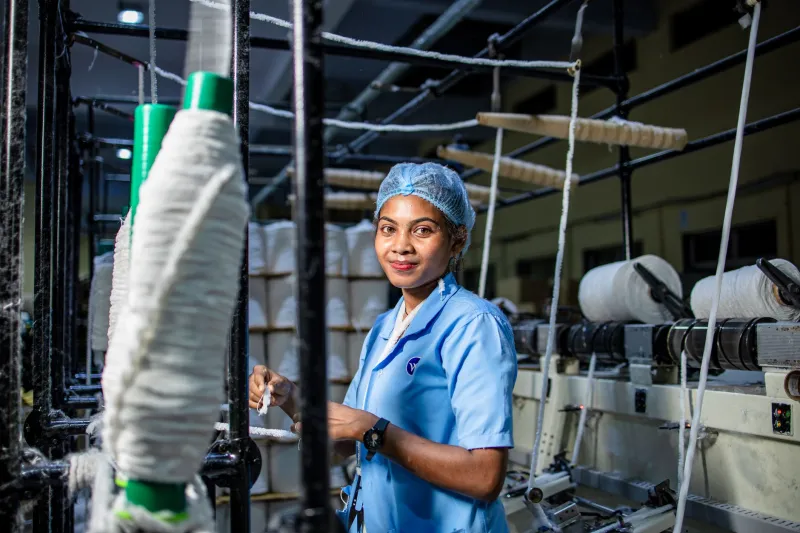
The Machine Is Ready. The Operator Isn't: How Eurasian Expos Are Exposing a Talent Crisis Inside US Print Shops
There is a particular kind of discomfort that settles over experienced print buyers when they stand in front of a machine they know they cannot staff. It is not the discomfort of sticker shock, nor the familiar hesitation that precedes a capital expenditure negotiation. It is something more unsettling: the recognition that the limiting factor is no longer the equipment itself, but the human being expected to run it.
That feeling has become increasingly common among US print professionals attending major Eurasian trade events—from drupa in Düsseldorf to FESPA Global Print Expo in Amsterdam, from APPPEXPO in Shanghai to SIGN India in Mumbai. The machinery on display at these shows has crossed a threshold. AI-assisted color management, automated substrate switching, real-time defect detection powered by machine vision—these are no longer prototype features. They are production-floor realities being sold to shops of every size. And for a significant portion of American buyers walking those aisles, the honest answer to the question "can your team run this?" is: not yet.
What the Show Floor Is Actually Revealing
Trade shows serve many functions—they are marketplaces, networking venues, and competitive intelligence gatherings. But they also function, unintentionally, as diagnostic tools. When a printer spends three days watching live demonstrations of systems that integrate prepress, production, and post-press into a single AI-monitored workflow, they return home with a clearer picture of where their own operation stands relative to the global standard.
The picture emerging from recent Eurasian expos is not flattering for a meaningful segment of the US market. European equipment manufacturers, in particular, have accelerated their integration of machine-learning features into mid-range press lines—not just flagship models. Systems that once required a dedicated software specialist to calibrate are now designed to self-optimize, but that optimization still demands an operator who understands what the machine is doing and why. The assumption embedded in these designs is a workforce that has grown up with digital interfaces, understands data feedback loops, and can interpret automated alerts with confidence.
That assumption does not always hold in American shops, particularly those built around operators trained on analog or early-digital workflows. The concern is not that these workers are incapable of learning—they are not. The concern is that the learning curve has grown steeper precisely as the labor market has grown tighter.
A Mismatch Years in the Making
The talent gap in US printing did not appear overnight. Industry observers have tracked declining enrollment in graphic communications and print technology programs at community colleges and trade schools for over a decade. Retirements accelerated during and after the pandemic, pulling experienced press operators out of the workforce faster than apprenticeship pipelines could replace them. Meanwhile, the definition of "qualified operator" has shifted dramatically.
A skilled offset press operator from 2010 brought tremendous value to a shop floor. That same individual, without retraining, may struggle to navigate the touchscreen diagnostics panel of a 2024 inkjet production line with integrated spectrophotometer feedback. This is not a commentary on individual competence—it is a structural observation about how quickly the technical baseline has moved.
What Eurasian trade shows make viscerally apparent is the pace of that movement. European manufacturers, responding to their own labor pressures, have engineered machines that are designed to reduce operator dependency while simultaneously requiring operators who are more technically sophisticated. It is a paradox that American buyers are only beginning to fully internalize.
How Forward-Thinking US Print Houses Are Responding
Not every US printer is caught flat-footed. A growing cohort of forward-thinking shops has begun treating trade show attendance as a workforce planning exercise, not merely a procurement one. Before committing to a new press line, these operators are sending their floor supervisors and lead operators to expo demonstrations—not just their owners or sales managers—to assess training requirements firsthand.
Some are going further. A handful of larger commercial printers have established formal partnerships with European equipment vendors to access their training academies, either by sending staff abroad or by negotiating on-site training packages as part of purchase agreements. Others are working with community college programs to co-develop curriculum around specific equipment lines, essentially building the training pipeline that the broader industry has failed to construct.
There is also a quieter trend worth noting: some US print shops are deliberately slowing their equipment upgrade cycle—not because they lack capital, but because they lack confidence in their ability to staff the machines. This represents a meaningful competitive risk. While they wait, better-staffed competitors will absorb the productivity and quality advantages that next-generation equipment delivers.
The Asian Dimension
The talent conversation looks somewhat different when the lens shifts from European to Asian trade floors. Shows in China, South Korea, and India are revealing a different kind of skills dynamic. In these markets, the rapid buildout of print manufacturing capacity has been accompanied by aggressive workforce development investment—often state-supported. Young operators in Chinese print facilities are being trained on AI-assisted systems from the start of their careers, without the legacy knowledge gaps that complicate retraining in the US context.
For American print buyers, this creates a dual pressure. On one hand, they are watching Asian competitors operate advanced equipment with trained workforces at lower labor costs. On the other hand, they cannot simply import that workforce model. The answer, as several US industry educators have begun arguing publicly, lies in treating operator training as a capital investment equivalent to the equipment purchase itself—budgeting for it, scheduling it, and measuring its return.
What Needs to Change
The equipment-to-talent mismatch will not resolve itself through market forces alone. Trade associations, equipment vendors, and print employers all have roles to play, and the signals coming from Eurasian trade floors should be accelerating those conversations rather than allowing them to drift.
For US print shop owners, the immediate practical step is to audit current staff capabilities against the technical requirements of equipment they are actively considering—before signing a purchase order, not after delivery. For vendors selling into the American market, there is both a commercial and ethical argument for being more transparent about training requirements during the sales process. And for workforce development organizations, the data from trade shows offers a real-time curriculum roadmap that classroom programs have historically been slow to incorporate.
The machines on display in Cologne and Shanghai are not waiting. They are already in production facilities across Europe and Asia, running shifts, hitting margins, and widening the gap. The question for American print is not whether to close that gap, but whether the industry will act with enough urgency to close it before the competitive damage becomes irreversible.