Robots on the Floor, Humans at the Drawing Board: Why Asian Automation Is Opening Doors for US Promo Designers
The narrative has been circulating for years: Asian factories automate, costs drop further, and American promotional products professionals face an existential squeeze. It is a compelling story. It is also, at least for now, incomplete.
A closer examination of how automation is actually being deployed across Chinese, South Korean, and Vietnamese promo manufacturing facilities reveals something more nuanced than a straightforward displacement story. The efficiency gains are real. The cost advantages are measurable. But the structural changes automation introduces are simultaneously creating a narrow—and potentially widening—window for US designers and custom specialists to compete in ways that large-scale robotic production fundamentally cannot replicate.
Understanding why requires looking past the headlines about robot-staffed factories and into the specific economics of what automation optimizes for, and what it inherently deprioritizes.
What Automation Actually Does Well—and What It Doesn't
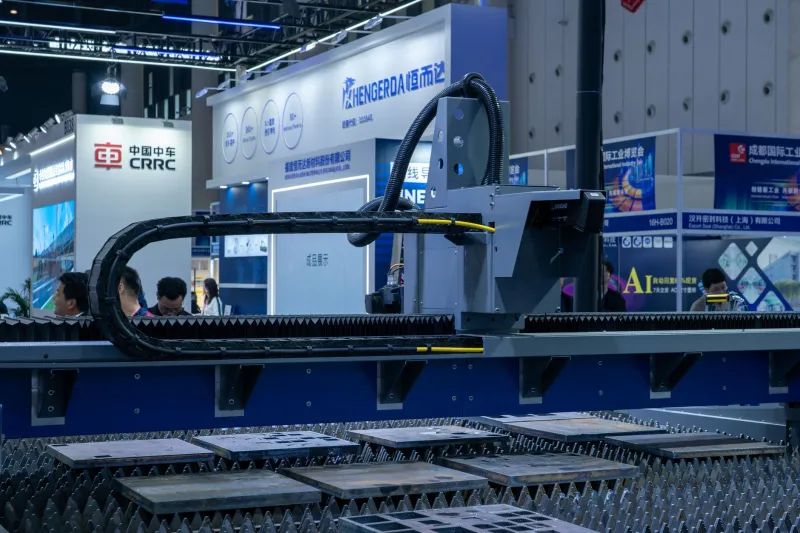
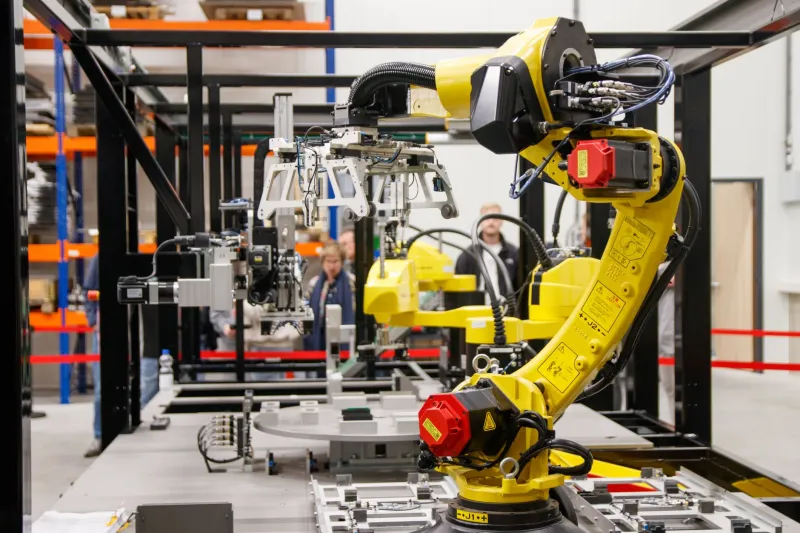
In Guangdong province, facilities producing branded merchandise at volume have integrated robotic arms, vision-guided quality control systems, and AI-assisted design replication tools into production lines that operate around the clock with minimal human intervention. Output consistency at scale has improved dramatically. Per-unit costs on standardized items—pens, tote bags, lanyards, drinkware—have compressed further than most US buyers anticipated even five years ago.
But automation, as currently deployed in promotional manufacturing, is optimized for repeatability. A robotic system excels when it is producing ten thousand identical units of a pre-approved design. It struggles—or more precisely, becomes economically inefficient—when the brief calls for fifty units of a highly personalized item, a rapid design iteration based on client feedback received forty-eight hours before a product launch, or a piece that requires tactile judgment calls during production.
"The machines are extraordinary at doing the same thing perfectly, over and over," notes one regional manufacturing consultant who works with both Asian producers and US distributor networks. "What they cannot do is interpret a brand manager's mood on a Tuesday afternoon and translate that into a sample revision by Thursday morning."
This distinction matters enormously for a specific segment of the US promotional products market.
The Personalization Premium
The US promotional products industry has been moving, incrementally but persistently, toward higher-value custom work. Corporate gifting programs, experiential marketing activations, and direct-to-consumer branded merchandise drops all share a common thread: the premium is not on volume, it is on distinctiveness.
For a Fortune 500 company commissioning a limited-edition executive gift, the ability to iterate on design in real time, incorporate last-minute brand guidelines, and deliver a finished product within a two-week window is worth paying for. Significantly. The cost differential between a US custom promo specialist and an automated Asian production line narrows considerably—or disappears entirely—when speed and personalization are the primary value drivers.
This is not a theoretical market position. US distributors and designers who have deliberately repositioned toward premium custom work report that their Asian competitors, despite automation advantages, are not their primary competition in this segment. Their competition is other US specialists.
"We stopped trying to compete on price for commodity items three years ago," says one promotional products designer based in the Midwest who requested anonymity to speak candidly about competitive positioning. "Our clients now come to us specifically because they know we can turn a concept into a physical sample in days, not weeks, and because we understand their brand well enough to push back when a design direction isn't going to work in production. No robot does that."
The Speed Asymmetry
Beyond personalization, speed represents perhaps the most durable competitive advantage available to US-based promo specialists. Automated Asian facilities have optimized production speed, but they have not compressed ocean freight timelines. A product produced in Shenzhen still requires three to five weeks of transit time to reach a US client, plus customs clearance, plus domestic logistics.
For an increasing proportion of promotional campaigns—product launches, event activations, crisis communications responses, and opportunistic marketing moments—a six-to-eight-week total lead time is simply incompatible with campaign realities. US producers, even those without automation parity, can service these requirements in ways that geographically distant, highly automated competitors cannot.
Automation in Asia has effectively bifurcated the market: commodity volume at compressed cost on one side, speed-sensitive custom work on the other. American designers who recognized this bifurcation early have positioned themselves almost exclusively in the latter category.
Where the Window Could Close
Intellectual honesty requires acknowledging that this window is not guaranteed to remain open indefinitely. Several developments bear watching.
Generative AI design tools are improving rapidly, and their integration into automated production workflows could meaningfully reduce the iteration speed gap between Asian manufacturers and US specialists. If a factory in Vietnam can accept a rough creative brief, generate design variations through AI, and begin production within twenty-four hours, the personalization advantage narrows.
Additionally, nearshoring trends in promotional manufacturing—with facilities expanding in Mexico, Eastern Europe, and Turkey—are creating a new competitive tier that combines geographic proximity with increasingly automated production capabilities. These facilities are not yet at Chinese scale, but they are growing.
US promo designers who treat the current window as a permanent structural advantage rather than a temporary asymmetry risk being caught unprepared when these dynamics shift.
What Forward-Thinking US Specialists Are Doing Now
The most strategically sophisticated US promotional products designers are not simply exploiting the current gap—they are building capabilities that will remain relevant even as automation and AI advance.
Deep brand relationships represent the most durable moat. A designer who has worked with a client across multiple campaigns, understands their visual language, knows their internal approval processes, and has established trust with their marketing team is providing value that cannot be replicated by a more efficient factory, regardless of its automation level.
Material innovation is another area where human expertise continues to command a premium. Identifying emerging materials, understanding their production properties, and advising clients on what is achievable requires knowledge that AI tools are only beginning to approximate.
Finally, regulatory fluency is increasingly valuable. As US corporate clients face growing scrutiny over supply chain sustainability, chemical compliance, and ethical manufacturing standards, the ability to navigate these requirements—and to source or produce accordingly—differentiates specialists from commodity suppliers in ways that are genuinely difficult to automate.
The Broader Lesson
The automation wave rolling through Asian promotional manufacturing is real, consequential, and ongoing. But its effects are not uniformly negative for American industry participants. For those willing to examine the structural changes honestly and position accordingly, the same forces driving displacement in commodity production are simultaneously creating demand for capabilities that remain distinctly human.
The robots are on the factory floor. The drawing board, for now, still belongs to the designer.